







Applied Psychologist, Human-AI Interaction
Doctoral Researcher (PhD abd)
Former NBC Reporter
Creator, Human Readiness Framework™
Chair, IEEE Organizational Readiness for Human-AI Interaction
Advisor, Harvard AI for Human Flourishing Global Council
Head, Oxford Human Flourishing with AI Collab Lab (2026)
Collaborator, Oxford AI in Education Hub (AIEOU)
MIT AI & Human Flourishing Benchmarks Collaborator
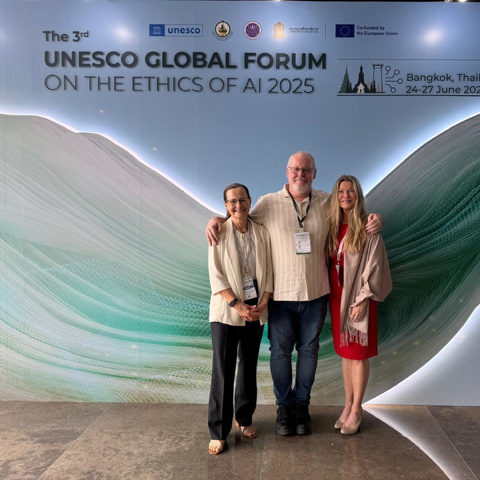
UNESCO 3rd Global Forum participant
Pulitzer Center AI Reporting
The Athens Roundtable Collaborator
AvaResearch, AI Action Summit, Scientific Advisor
Dubai Future Forum
STEMM Scholar, Science for Development Institute
University of Cambridge (Cognitive Psychology/Neuropsychology)
APA, Human Factors (AI)
Worked with Forbes, Stanford, NASA
Mel Sellick
Founder, Future Human Lab
Applied psychologist, doctoral researcher, former NBC reporter.
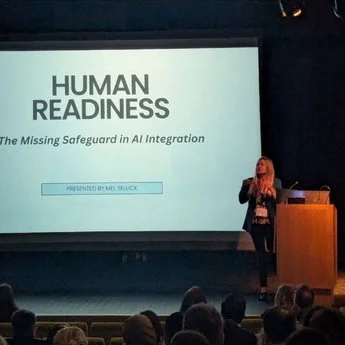
My career reflects one conviction: the most consequential questions about technology aren't technical, they're deeply human. That conviction produced the Human Readiness Framework, created to close a gap nobody else was addressing: everyone focused on AI literacy and ethics, but no one systematically examined whether humans were psychologically, cognitively, and relationally prepared for these tools. The Framework now informs IEEE's first global standard for organizational readiness, shapes UNESCO's AI education policy, and is implemented by universities and frontier AI companies worldwide.
The data is unambiguous. A Microsoft study of 37.5 million conversations found the same AI functions as work partner on desktop and personal confidant on mobile. Over 220 million AI companion app downloads. Therapy is now ChatGPT's most common use case. The problem isn't carelessness or malice, it's the myth of the reasonable user: the assumption that deployment equals readiness, exposure equals capability, adaptation is automatic. It isn't. Readiness is psychological, cognitive, and relational. It's distributed unevenly. The same system that supports one person undermines another, depending on stress, loneliness, and circumstance. What concerns me most isn't a dramatic event. It's the gradual, normalized reshaping of who we are.
We're also watching an attachment economy emerge, where systems exploit human bonding for profit. Not attention hacking. Attachment hacking: targeting identity, belonging, and selfhood. Regular AI use reduces effortful thinking. Confidence grows faster than understanding. These shifts feel normal precisely because they're gradual. That's why I build FHL publicly, in dialogue rather than isolation. Families need guidance. Organizations need frameworks. Researchers need each other. Readiness isn't automatic. It has to be cultivated.